

Table of Contents:
Restoring vintage furniture is a satisfying, intricate, and often lucrative hobby. Taking the time to hunt for unique pieces and return them to their former glory is truly a labor of love. If you’re just getting started restoring vintage furniture, the tips below can help guide you through the process, brought to you by NSA Storage, the place where millions of Americans store their furniture and other belongings!
Before Starting, Evaluate the Vintage Piece
Knowing what you’ve got in front of you before you start restoring can save you time, money, energy, and headaches.
Before you begin, ask these questions:
- Is the piece vintage or an antique? Antiques, generally speaking, don’t need restoration, they need preservation.
- Are any joints loose or broken?
- Are there deep scratches, dents, or stains?
- Is the upholstery in okay shape, or is it in need or repair or replacement?
Answering these questions will help you evaluate your needs, prioritize repairs, and help you gather tools and materials.
If Needed, Stabilize Before Restoring
It’s not unusual for some vintage furniture to come with blemishes, which are typically easy to repair. Structural damage, however, is something you need to address before fixing cosmetic issues. If you try to make repairs to a vintage piece that’s unstable, you could damage it even further.
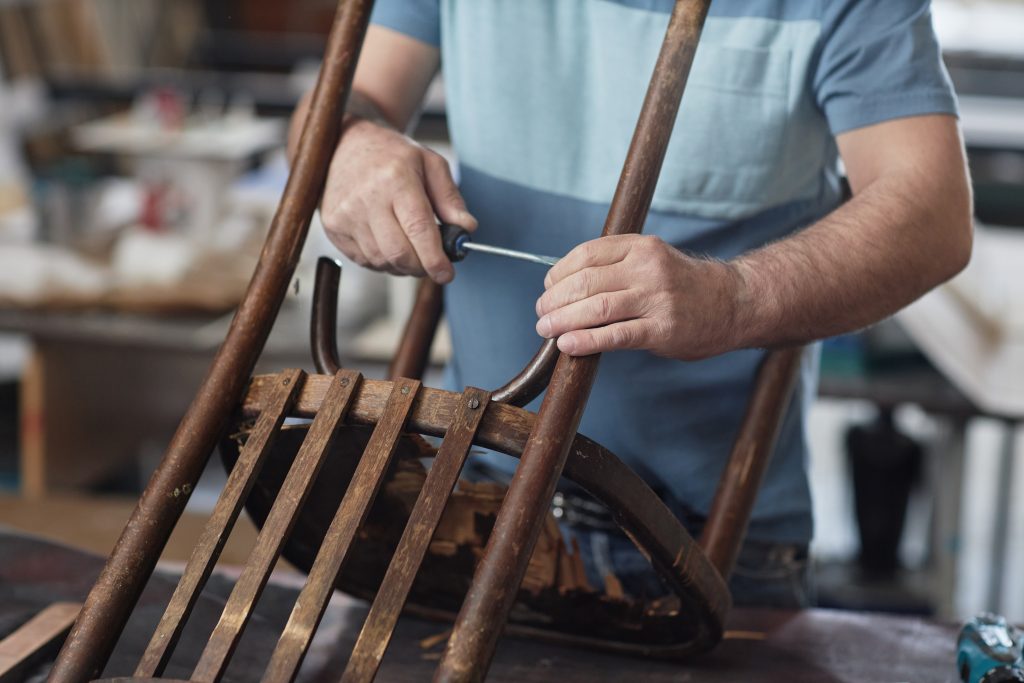
Structural repairs will likely fall along these lines:
- Loose or damaged joints
- Wobbly legs
- Wood that’s started to split due to rot or stress
- Damaged or missing hardware
When gluing together wood parts, use clamps and let the glue cure before starting the restoration. Keep in mind that you might need to tighten nuts and bolts, also.
Clean Vintage Pieces Well Before Stripping
When you pick up a piece of vintage furniture it will often be in need of a deep clean. That grime, grease, dirt, dust and debris can usually be removed with minimal effort. Once clean, you may find that your restoration job has been cut in half!
In short, before using a strong stripping product, first:
- Wash the item with mild soap and warm water. (Damp cloth, not dripping wet.)
- If there’s grease, use a grease removing cleaner like Greased Lightning
- For carved or intricate areas, use a soft brush or old toothbrush.
After cleaning, your piece may not need stripping after all!
Only Strip Vintage Furniture When Absolutely Necessary
Chemical stripping products are very aggressive in removing paint, stain, shellac, etc. One problem with vintage furniture is that, if you use too much or the wrong product, you can damage or even ruin it.
The same goes for sanding, which can damage a piece’s finish and make your restoration project more difficult. For those reasons you should only strip a piece when there’s no other choice.
Some of the options you have when stripping vintage furniture include:
- Chemical strippers for pieces that can’t be sanded
- Light sandpaper for those that can
- Scrapers for large, flat surfaces
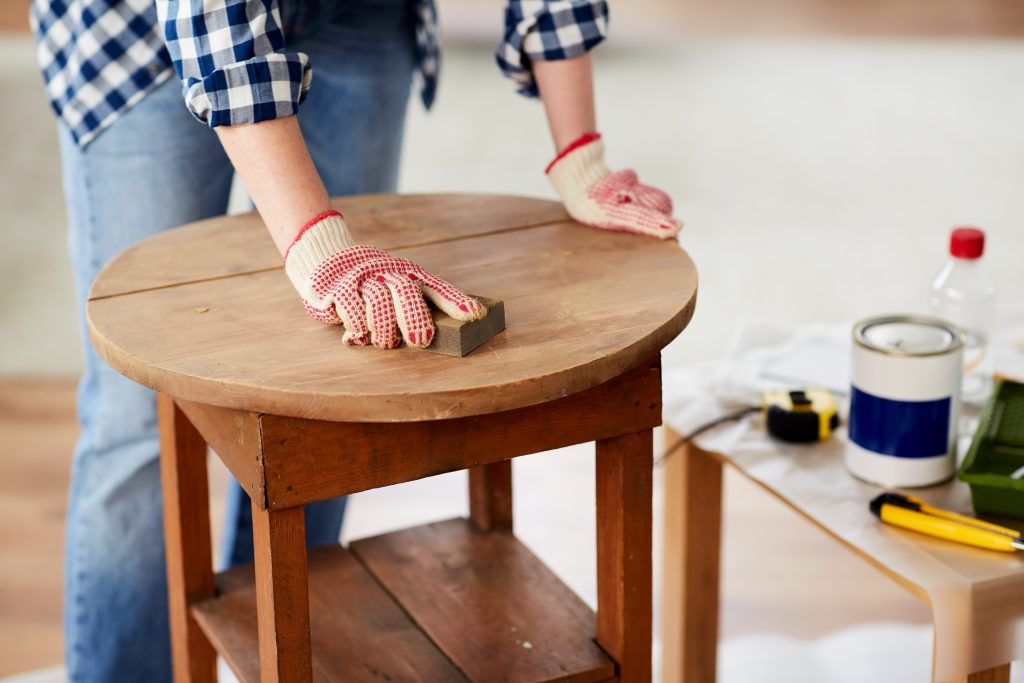
Also, keep these rules in mind when stripping vintage furniture:
- Use coarse sandpaper first and then progress to finer and finer grits
- Sand with the grain, not against it
- Once done, clean your piece fully before painting or staining it
Repairing Veneer
Veneer is fragile and tends to separate on vintage furniture, but if you handle it correctly, it’s no biggie. Here are a few tips to do it right:
- If the veneer is simply lifting off, use the correct glue to put it back, and clamp it down until cured. (Wood glue works best.)
- Use wood filler of the same color to fill missing patches of veneer.
- For small chips and cracks, use a marker of a similar color.
Matching the Piece’s Finish and Color
Matching the color and finish on a vintage furniture piece is more about blending than finding the perfect color match. If you can blend consistently, you should have a good end result.
To blend and finish sell, use:
- Gel stains, which give good control
- Layer stains to add depth
- Use glazes for an aging effect
Reupholster with Care and Purpose
Reupholstering is a bit tricky, especially for newbies. That said, it can also completely modernize and revamp a vintage piece while keeping its charm and allure.
Here are a few reupholstering tips to help you do it well:
- Be very careful when removing old upholstery so you don’t damage the item
- If needed, replace the padding or stuffing
- Carefully cut a new piece of fabric to the correct size. (Measure twice, cut once.)
- Use either a heavy-duty staple gun or tack to attach the new fabric
- Smooth wrinkles as you go
- Finish the edges
Storing Restored Vintage Furniture
If your plan is to restore a single piece of vintage furniture, you probably won’t need to store it. If, however, you plan to restore many, or plan to sell your pieces, a self-storage unit can be very helpful.
Furniture, whether vintage or new, takes up a lot of space. If you have lots of restored pieces waiting to sell, you’ll need somewhere to put them so your home doesn’t fill up!
A storage unit solves that problem. Here’s how:
- You can store your restored pieces there, not at home
- You can organize them in storage
- Taking photos to sell them online will be easier
- You can store your tools and materials in your storage unit
- They will be safe and secure in storage
Do Your Restoration Work in an NSA Storage Unit
Hopefully you got some great tips for restoring vintage furniture today that will help you on your journey. It’s a fun hobby, no doubt, and can be a great side hustle, too.
As we mentioned, if you need to reserve a storage unit for your restored vintage pieces, NSA Storage can help. Our clean, safe, and secure storage centers are all around the country, ready to help you store vintage furniture today!
Visit us online or visit your local NSA Storage facility in person to rent a self-storage unit. Until then, best of luck restoring vintage furniture for your own pleasure or profit!